Every other psychedelic shows you more.This one shows you less.
- 5-HT1A
- Non-Visual
- Minutes
Not all psychedelics are the same
Psilocybin, LSD, ayahuasca — they alter perception. They produce imagery. They surface material. They can give you a new way to tell your story.
5-MeO does none of that. Time, space, and the sense of being a self located somewhere, looking out — these are not altered. They are briefly suspended. Researchers who study it call the resulting state deconstructed consciousness.
Every other tool works on the identity. It gives you distance from it, insight into it, a better version of it. 5-MeO does something categorically different: it briefly removes the assumption the identity is standing on — that there is a you in here and a world out there.
That assumption is where the whole structure begins. It is also the one thing no amount of work has ever reached.
Less story. Less identity. Less separation. Not more of you. Less of what was never you.
This is not a trip
No cosmic visuals. No spirit animals. No messages from your childhood.
- No imagery to interpret afterward
- No narrative, no symbolism, no message
- The assumption of separation, briefly suspended
- The operation that builds the self, briefly offline
This is not a psychedelic trip. It is the undoing of the one who trips.
What makes 5-MeO unique
Non-Visual
5-MeO binds preferentially to the 5-HT1A serotonin receptor. Psilocybin and LSD act primarily at 5-HT2A — the receptor where visual content originates. Different receptor. Different mechanism. Nothing to see.
Fast-Acting
Inhaled, the effects begin within seconds and resolve within ten to thirty minutes. Rapidly metabolised, and it clears fully. No long descent.
Naturally Occurring
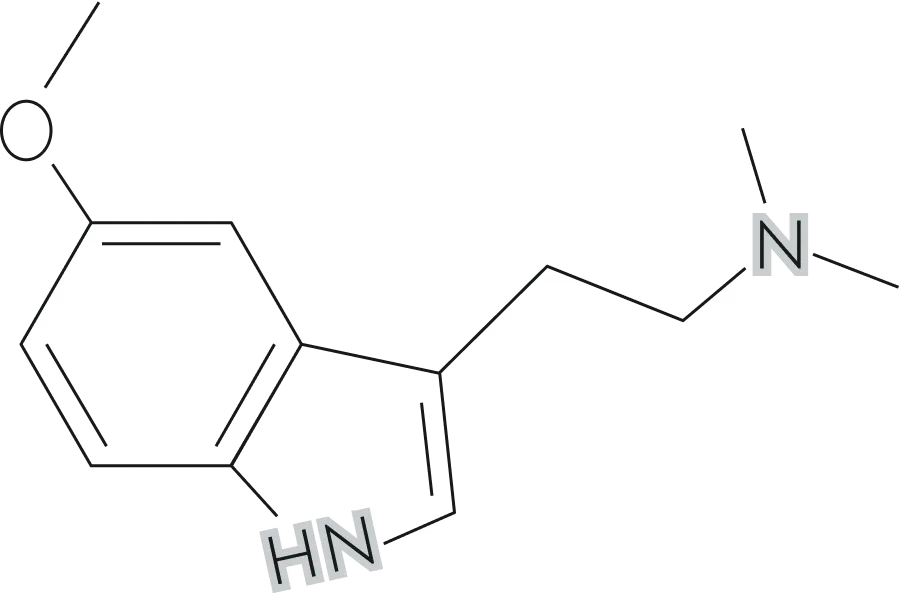
5-MeO-DMT occurs in certain plants, in the secretion of one toad species, and has been detected in trace amounts in mammalian tissue. It is not exotic chemistry. It is a close structural relative of serotonin.
What we use
Synthetic. Pharmaceutical-grade, lab-purity-tested, structurally identical to the molecule described above, and the form used in clinical trials.
5-MeO-DMT was first synthesised in a laboratory in 1936. It was identified in the secretion of the Sonoran Desert toad in 1965, and the practice of smoking that secretion spread from a pamphlet published in 1984. Synthetic is not a modern substitute for an older tradition. It predates that tradition by nearly fifty years.
You may also have heard that smoking the secretion is an ancestral practice of the Comcáac people of Sonora. Researchers who have worked in the region document that account as an invention of the last fifteen years, introduced to that community from outside, and carrying consequences for it that are still being written about.
The rest of the objection is analytical. Toad secretion contains 5-MeO alongside bufotenin and other alkaloids, in proportions that vary from animal to animal and that nobody has measured for the dose in front of you. A physician cannot clear a dose that has not been quantified, and a staged sequence cannot be calibrated against an unknown. Everything else on this site depends on knowing what is in the vial.
The species and the communities around it are under pressure from exactly this practice.1 That is a real reason and it is not the first one.
The science behind the substance
5-MeO-DMT (5-methoxy-N,N-dimethyltryptamine) is a tryptamine — structurally, a close relative of serotonin.
Its distinguishing feature is receptor selectivity. It binds the 5-HT1A serotonin receptor with several hundred times the affinity it has for 5-HT2A.2Psilocybin and LSD work primarily through 5-HT2A. That is where the visual content comes from.
This is not a minor difference. It is the mechanical reason there is nothing to see, nothing to narrate, and nothing to interpret afterward.
An exploratory EEG study of the 5-MeO state, conducted in naturalistic settings, found reductions in alpha and posterior beta power — a signature consistent with a brain in which top-down predictive models are temporarily inhibited.3Those are the models that assemble a stable world, and a stable self standing separately inside it. Researchers describe the resulting state as deconstructed consciousness.
That is the mechanism. Not insight. Not catharsis. A temporary interruption of the process that assembles the sense of being someone, separate, here.
Where the research is
In October 2025 the U.S. Food and Drug Administration granted Breakthrough Therapy designation to BPL-003 — an intranasal formulation of mebufotenin (5-MeO-DMT) developed by Beckley Psytech and atai Life Sciences, since merged as AtaiBeckley — for treatment-resistant depression. Following a successful End-of-Phase 2 meeting with the FDA, the company aligned on a two-study Phase 3 program.4The Usona Institute has completed a Phase 1 study of 5-MeO-DMT. GH Research is in Phase 2 with a 5-MeO compound for the same indication.5
In September 2026 Eli Lilly completed its acquisition of AtaiBeckley for approximately $2.8 billion, with up to $1 billion more tied to development and regulatory milestones. Initial Phase 3 results are expected in early 2029.6
None of that is ours. It belongs to a pharmaceutical company, a specific formulation, and a specific clinical indication — a nasal spray, given in a clinic, for treatment-resistant depression. It makes no claim about what we do, and we are not going to pretend otherwise.
What it tells you is narrower, and it is the only thing we would ask you to take from it. The regulator no longer treats this molecule as fringe.
In their words
Nothing around me has changed, and I have changed quite a bit. The first thing that I've told close people around me is that it was like there was an emotional reset button, and I really mean that. Like a button or a switch that was just pressed.
I feel free. People have told me that I feel lighter around them.
What it requires
This molecule is powerful. It's fast. It's direct. And it requires responsibility, readiness, and respect.
Used recklessly, it is dangerous. Used ceremonially, it tends to become an experience someone collects. Used precisely, inside a container that prepares you beforehand and holds you for months afterwards, it reaches a layer nothing else reaches.
- Screened
- Contained
- Precise
- Short
What we don't pretend
5-MeO carries real contraindications. It interacts dangerously with MAOIs and with some psychiatric medications. It raises heart rate and blood pressure. A minority of people experience reactivations in the days that follow.
This is why eligibility is determined by a licensed physician, and not by us. It is why nobody reaches the day without clearing that first. And it is why anyone who tells you this is safe for everyone is selling you something.
Eligibility is not ours to decide. A physician does that, and not everyone gets through it.
If this is the question you keep coming back to, the next step is a conversation.
- Ortiz Bernal et al., "Fabricated ancestrality: The Sonoran Desert toad, psychedelic globalization, and the ecological politics of 5-MeO-DMT," Psychedelics, March 2026 — no record of a toad-smoking tradition predating the 1984 pamphlet, and the account of Comcáac ancestral use documented as introduced from outside the community. "Toad in the road: Biocultural history and conservation challenges of the Sonoran Desert Toad," Journal of Psychedelic Studies 7(S1): 68–79, 2023, DOI 10.1556/2054.2023.00269 — harvesting pressure on Incilius alvarius, and separately the exploitation and biocultural erosion documented around the communities the practice is attributed to. The pamphlet was written by Ken Nelson, as Albert Most, in the summer of 1983 and published through Venom Press in 1984; secondary sources split between the two dates for that reason.
- Reckweg et al., "The clinical pharmacology and potential therapeutic applications of 5-methoxy-N,N-dimethyltryptamine (5-MeO-DMT)," Journal of Neurochemistry, 2022. Two receptor-binding studies (Ray, 2010; Halberstadt et al., 2012) converge on 300–1000-fold selectivity for 5-HT1A over 5-HT2A.
- Timmermann C, Sanders JW, Reydellet D, et al., "Exploring 5-MeO-DMT as a pharmacological model for deconstructed consciousness," Neuroscience of Consciousness, 2025(1): niaf007. An exploratory observational study conducted in naturalistic settings; the authors note its limitations.
- atai Life Sciences and Beckley Psytech, Breakthrough Therapy designation, 16 October 2025. AtaiBeckley, "Successful End-of-Phase 2 Meeting for BPL-003," 3 March 2026 (two-study Phase 3 program; initiation targeted Q2 2026).
- Psychedelic Health, 22 October 2025 (Usona Phase 1; GH Research Phase 2).
- Eli Lilly and Company, "Lilly to acquire AtaiBeckley," press release, 16 July 2026; "Lilly completes acquisition of AtaiBeckley," 11 September 2026. AtaiBeckley, "BPL-003 Phase 3 Program Initiation on Track for Q2 2026," 10 March 2026 — cash runway reaffirmed through planned early-2029 topline readouts from both parallel Phase 3 studies. A company plan, not a regulatory commitment.